Otterly.AI and Peec AI are the strongest all-round AI visibility tools for most agencies in 2027, while Profound leads for enterprise retainers and Semrush or Ahrefs Brand Radar make the most sense if your team already lives inside an SEO suite.
Picking the wrong tool gets expensive fast at agency scale. A platform that looks cheap for one brand can blow past your retainer margin once you multiply seats, client workspaces, extra AI engines, and daily prompt checks across 10 or 25 accounts. On top of that, clients now expect proof across ChatGPT, Google AI Overviews, Perplexity, and Gemini rather than a single ranking chart.
This guide compares 10 major AI visibility and GEO platforms on agency economics, engine coverage, client reporting, and workflow depth. All pricing was verified on vendor pages and public documentation in November 2026, listed in US dollars, and linked in the sources section below.
Editorial note: Out The Purse runs organic and AI discovery programs for commercial brands. No vendor paid for inclusion or placement in this guide, and none of the links below are affiliate links.
Top AI visibility tools for agencies at a glance
Each tool below fits a distinct agency tier, from boutique shops running prospect audits to enterprise networks managing global brands.
| Tool | Best for | Monthly price (USD) | Key agency mechanics |
|---|---|---|---|
| Profound | Enterprise retainers and agent workflows | $99 base + $399/client (Agency Growth) | 10 pitch workspaces, 100 daily prompts/client, 400 agent credits, up to 10 engines on Enterprise |
| Peec AI | Pure-play analytics and clean client dashboards | $95 to $495 (Agency: $245 to $795) | Unlimited user seats, sentiment and citation shares, Looker Studio on higher tiers |
| Otterly.AI | Mid-sized agency rosters and prospect pitches | $29 Lite; $189 Standard; $489 Premium | Agency Partner adds pitch workspaces, 150 to 500 prompts, unlimited workspaces, Looker Studio |
| Semrush AI Visibility | Agencies already standardized on Semrush | $99/domain add-on (or bundled from ~$139+) | 25 daily prompts/domain, LLM crawler site audits, fits existing Semrush client reports |
| Ahrefs Brand Radar | Agencies running SEO programs on Ahrefs | Base plan ($129+) + $50 to $199 add-ons | 500M+ historical prompt index plus custom prompt packs linked to backlink and organic data |
| Scrunch AI | Dedicated multi-brand agency pods | $250 Core; $500 Agency Core | Agency Core includes 3 brand workspaces, 250 prompts, unlimited seats, AI referral tracking |
| AthenaHQ | Brand protection and hallucination tracking | $295 Starter ($245 annual); Custom Enterprise | 3,600 monthly credits across up to 11 engines, hallucination detection, content action agents |
| SE Ranking / SE Visible | Consumer-interface tracking on a mid-market budget | $89 SE Visible Basic; $129 SE Ranking Core | 75 daily prompts across 5 projects on SE Visible, browser-collected answers |
| Rankscale | Broadest engine coverage on flexible credits | $20 Essentials; $99 Pro; $229 to $780 Growth/Ent. | 17+ AI engines, 10 brand dashboards on Pro, REST API and white-label dashboards on upper tiers |
| Writesonic GEO | Pairing visibility tracking with content drafting | From ~$79 to $99 (billed annually) | Combines citation gap monitoring with built-in AI drafting and page optimization workflows |
Why agencies need dedicated AI visibility tracking in 2027
Search demand has not disappeared, but clicks to open-web websites have compressed sharply. In February 2024, Gartner predicted that traditional search volume would drop 25% by 2026. Total query volume held up better than expected, yet outbound clicks fell hard because answer engines resolve more buyer questions directly on the results page.
Independent studies across 2024 to 2026 show why agencies now treat AI citation share as a core KPI alongside paid media and organic rankings:
| Source | Key finding | What it means for agencies |
|---|---|---|
| Pew Research Center (July 2025) | Google users clicked a traditional link in 8% of visits when an AI summary appeared, vs 15% without one (zero-visit exits rose from 16% to 26%). | Ranking in the top three organic links no longer guarantees traffic when an AI summary sits above the fold. |
| Ahrefs (2025–2026 CTR studies) | Position #1 organic pages saw a 34.5% lower average CTR when an AI Overview appeared in Ahrefs’ initial study, deepening to 58% in its updated longitudinal study. | Clients lose top-of-funnel clicks even when traditional rank trackers show flat #1 positions. |
| Bain & Company (2025) | 80% of consumers rely on zero-click or AI-generated answers for at least 40% of their searches, driving an estimated 15% to 25% drop in organic web traffic. | Brand inclusion inside the answer matters more than blue-link position on commercial research queries. |
| SparkToro & Datos | Only 374 clicks per 1,000 US Google searches (and 360 in the EU) reach the open web. | Zero-click behavior was already the majority baseline before AI Overviews and AI Mode expanded further. |
| Semrush AI Search Study | Visitors arriving from AI search tools convert at 4.4x the rate of traditional organic search visitors, despite representing roughly 0.3% to 1.1% of total sessions. | Lower session volume does not equal lower revenue; AI referrals carry late-stage commercial intent. |
| Writesonic (July 2026) | Across 161,286 prompts, 72% to 73% of cited domains were cited by only one of four engines (ChatGPT, Gemini, Perplexity, Google AI Overviews). | Monitoring a single engine is blind reporting; agencies need multi-engine visibility per client. |
Because Writesonic sells GEO software, treat its 72% to 73% single-engine figure as directional rather than exact. Even with that caveat, the practical rule holds across every client account we audit: three to four engines (ChatGPT, Google AI Overviews or AI Mode, Perplexity, and Gemini) is the minimum credible panel for an agency retainer.
What agencies actually need from an AI visibility tool
Most AI visibility tools were built for in-house brand teams first and retrofitted for agencies later. Before you sign an annual contract, test every platform against six agency-specific requirements:
- Workspace isolation and seat economics: Adding a new strategist, an analyst, or a client stakeholder should not trigger a seat surcharge. Look for unlimited seats and cleanly separated client workspaces.
- Pooled prompts versus per-domain pricing: Some platforms pool prompts across unlimited brands (you can allocate 150 prompts to a flagship account and 30 to a smaller one). Others charge $99 to $399 per domain regardless of panel size, which crushes margin on smaller retainers.
- Pitch and audit workspaces: Winning new GEO retainers requires running a quick 15 to 30 prompt competitive snapshot for a prospect before they sign. Dedicated pitch workspaces save you from burning permanent client slots.
- Consumer-interface data versus raw API calls: API responses often differ from what buyers see in ChatGPT, Google AI Overviews, or Gemini in a browser. Ask each vendor how they collect answers and whether they save full answer snapshots you can show a client.
- Client reporting and data exports: Agencies need Looker Studio connectors, white-label PDFs or dashboards, or a clean REST API so AI citation metrics sit inside the same report as paid search, organic traffic, and pipeline.
- Citation URLs and sentiment, not just mention counts: Knowing a brand was mentioned in 35% of prompts is a vanity metric unless the tool shows which third-party URLs the engine cited and whether the answer got the client’s pricing or positioning wrong.
The 10 top AI visibility tools for agencies
Profound: best for enterprise agency retainers and agent workflows
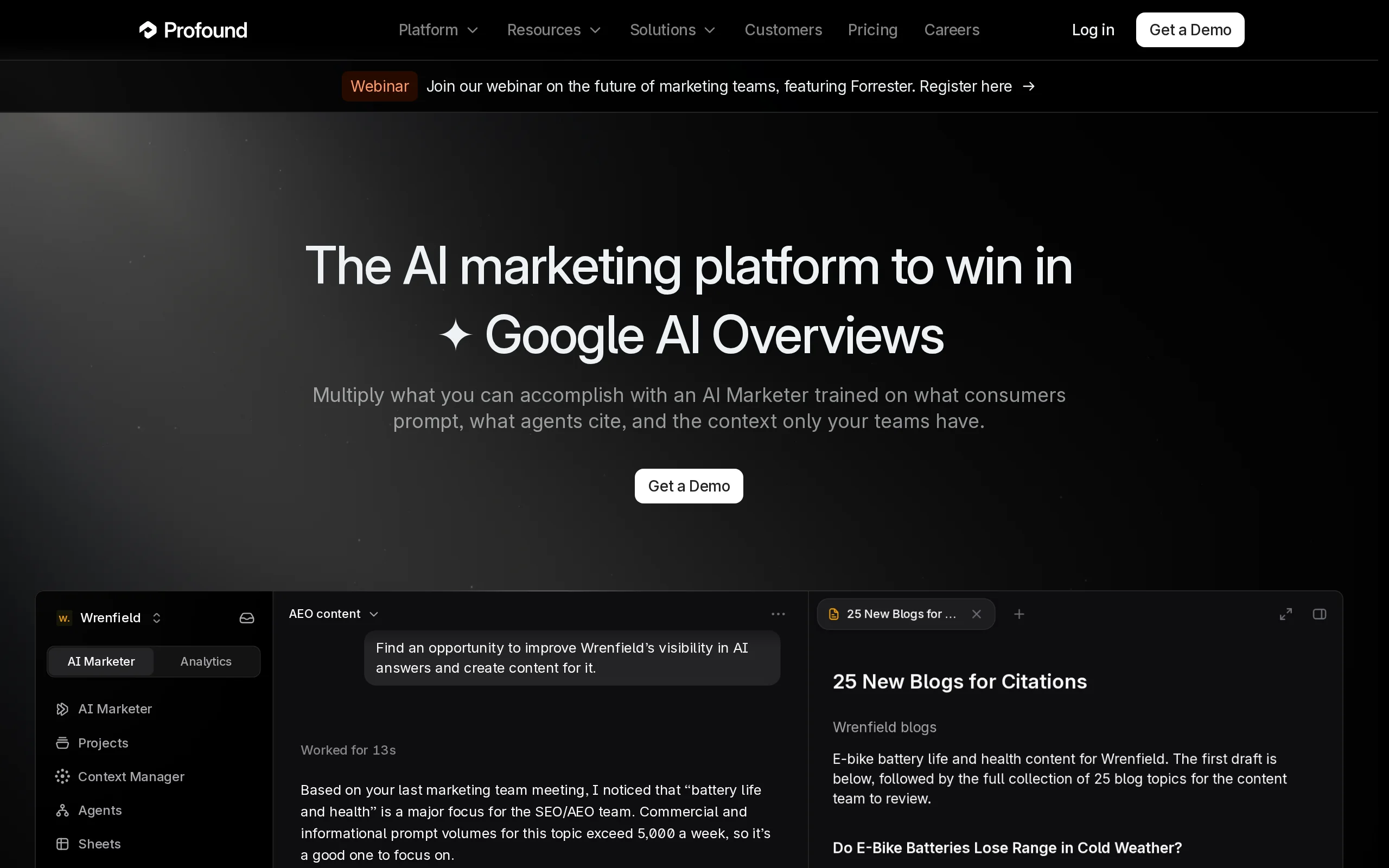
Profound pairs multi-engine AI search tracking with an AI Marketer workspace built for enterprise execution workflows.
Profound is the heaviest enterprise platform in the category and moved away from cheap brand self-serve plans in 2026 to focus on enterprise accounts and agencies. For agencies, its Agency Growth plan starts at $99/month base plus $399/month per active client workspace, including 5 agency seats, 10 prospect pitch workspaces per month, 100 daily prompts per client across core engines, and 400 AI Marketer agent credits.
Its Agency Enterprise tier unlocks up to 10 engines (including ChatGPT, Perplexity, Google AI Overviews, Google AI Mode, Gemini, Claude, and DeepSeek), API access, SSO/SAML, Conversation Explorer, and Agent Analytics for tracking AI crawler hits and referral attribution. Because Profound captures answers from browser environments and connects insights directly to automated content workflows, it holds up well in enterprise QBRs where CMOs scrutinize methodology.
- Choose Profound if your agency manages enterprise retainers ($8,000+/month) where $399 per client workspace is easy to absorb and clients want deep engine coverage, crawler analytics, and agent execution in one tool.
- Skip Profound if you run a roster of mid-market or SMB retainers under $3,000/month, where per-client workspace fees will quickly outpace your software budget.
Peec AI: best for pure-play analytics and clean client dashboards
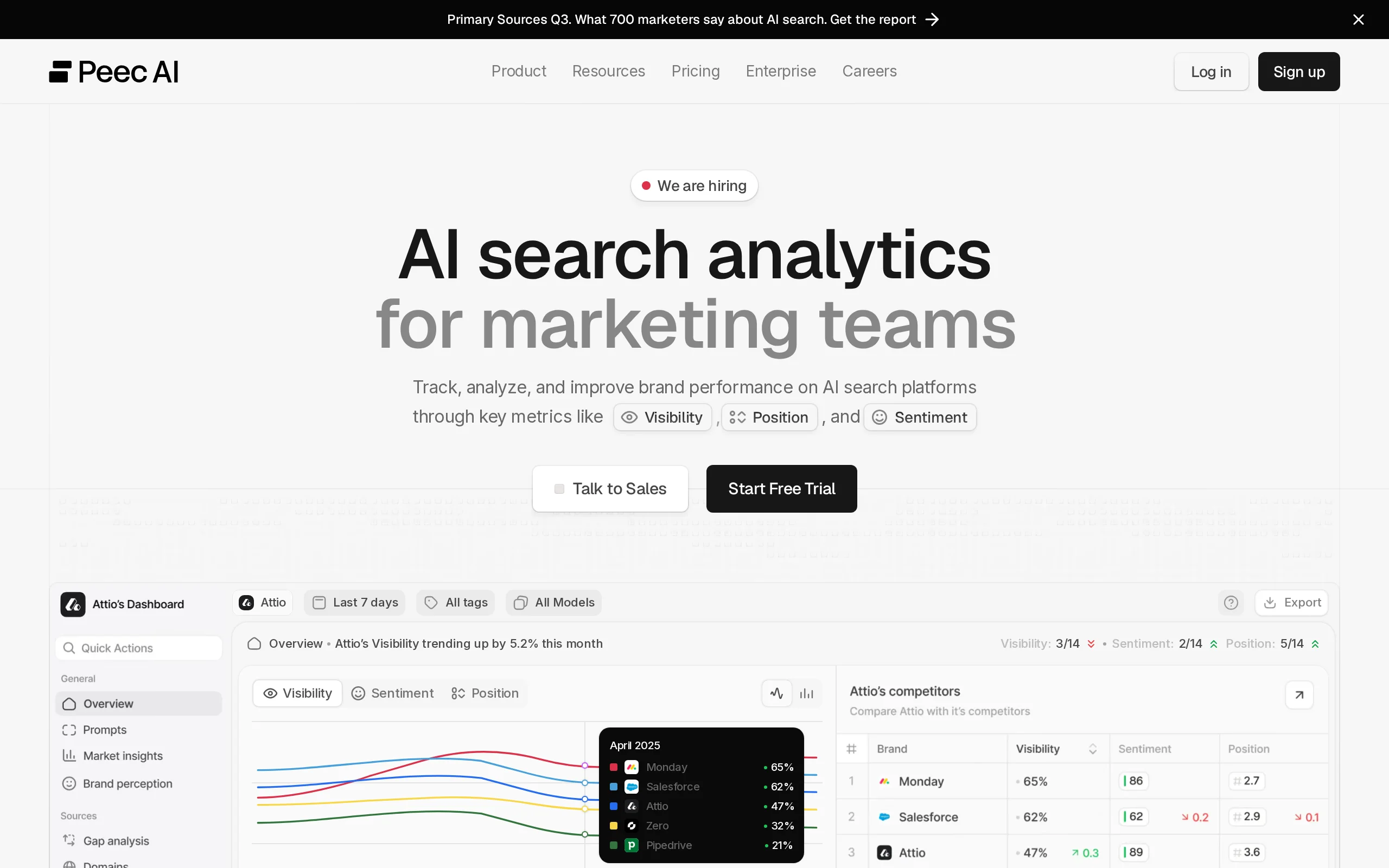
Peec AI focuses strictly on visibility, position, sentiment, and competitor benchmarking without bundling content generation.
Peec AI takes the opposite approach from bloated all-in-one suites: it focuses strictly on clean AI search analytics, competitor share of voice, brand positioning, sentiment, and citation source breakdown. Self-serve plans run $95/month (Starter: 50 prompts, 1 project), $245/month (Pro: 150 prompts, 2 projects), and $495/month (Advanced: 350 prompts, 5 projects, Looker Studio connector), while dedicated Agency plans typically scale from $245 to $795/month based on prompt volume and client count.
Every tier includes unlimited user seats, which makes client collaboration painless. The main trade-off is that base plans include three selected AI models out of the box, with additional engines (such as Claude or DeepSeek) billed as add-ons or custom tiers. Peec AI also deliberately skips automated AI content generation, which is a plus if your agency prefers human editors and technical SEOs to handle execution.
- Choose Peec AI if your agency already has strong content and technical SEO delivery and wants crisp, reliable visibility reporting with unlimited seats and Looker Studio exports.
- Skip Peec AI if you want built-in content writing agents or need six or more engines included at the entry price without add-on fees.
Otterly.AI: best for mid-sized agency rosters and prospect pitches
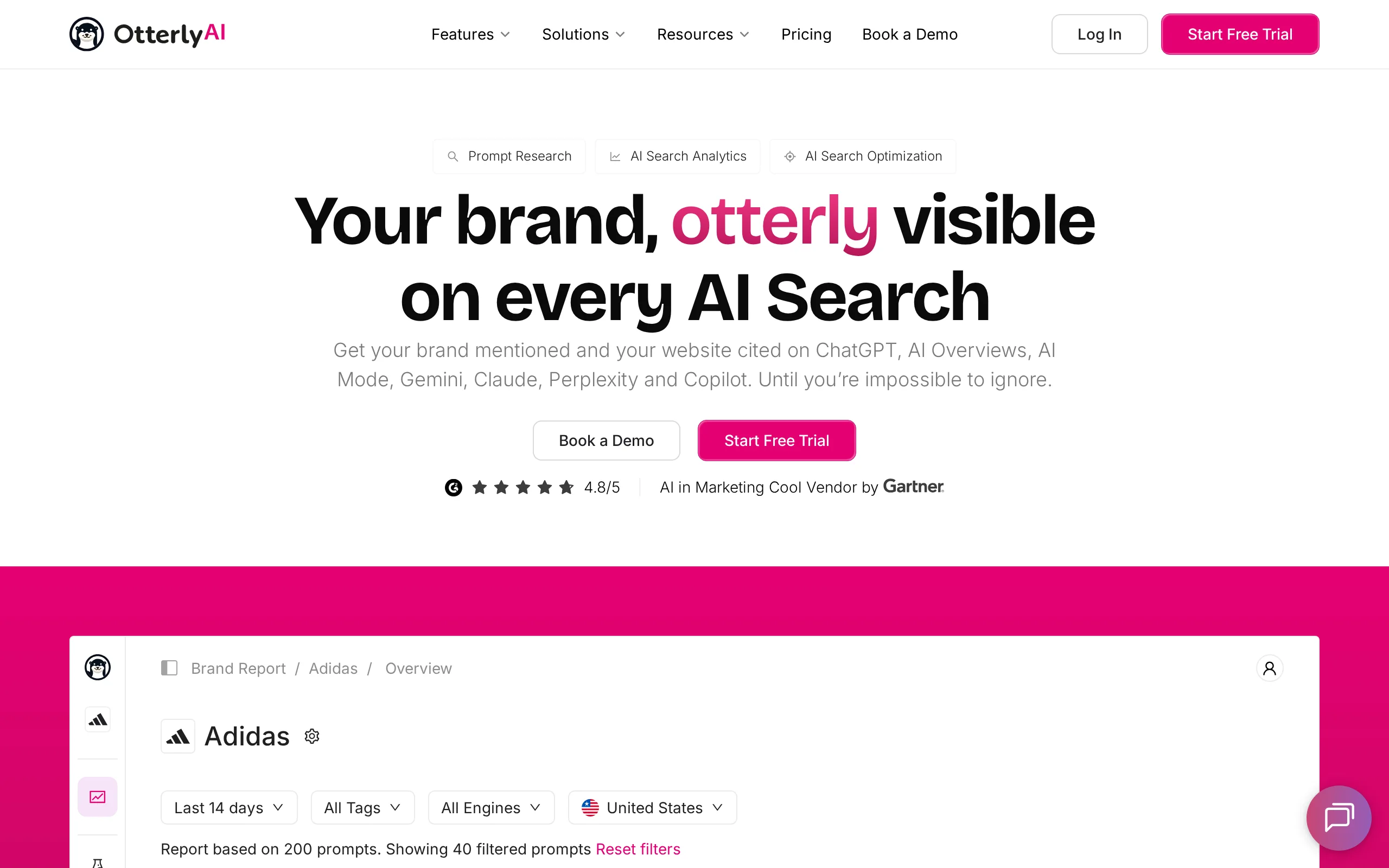
Otterly.AI structures prompt research, brand reports, and GEO audits around unlimited workspaces for Agency Partners.
Otterly.AI has become a staple for performance and SEO agencies because its pricing scales cleanly without locking you into enterprise sales calls. Public plans start at $29/month (Lite, 1 workspace) for single-brand testing, then step up to $189/month (Standard) and $489/month (Premium), with a 15% discount on annual billing.
Subscribing to Standard or Premium lets you join Otterly.AI’s Agency Partner Program, which bumps prompt allowances (to 150 prompts on Standard and 500 on Premium), unlocks unlimited client workspaces, adds dedicated prospect pitch workspaces, provides white-label Looker Studio reporting, and consolidates invoices. Core plans track four engines (ChatGPT, Google AI Overviews, Perplexity, and Microsoft Copilot), with Gemini, Claude, and Google AI Mode available as modular add-ons, plus built-in GEO audits and query fan-out research.
- Choose Otterly.AI if you manage 5 to 20 clients, pitch prospects regularly, and want unlimited workspaces, unlimited team seats, and modular engine control under $500/month.
- Skip Otterly.AI if you need every niche model included in the base fee without paying for engine add-ons, or if you want an execution agent that drafts pages for you.
Semrush AI Visibility Toolkit: best for agencies already standardized on Semrush
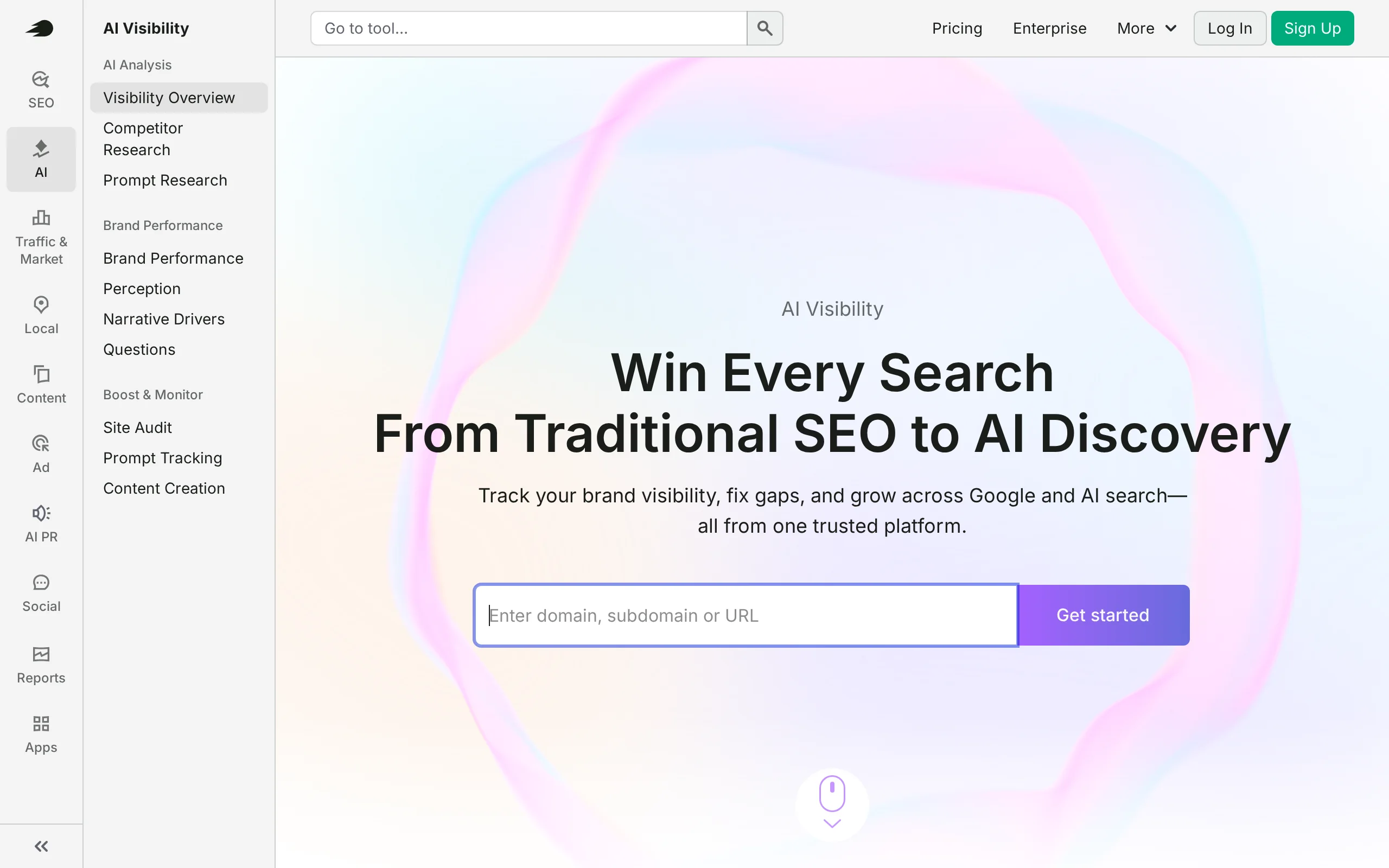
Semrush places AI Visibility Overview, Brand Performance, and AI Search Site Audit directly inside its existing SEO sidebar.
Semrush integrates AI visibility tracking directly into the SEO suite most agencies already use for keyword research, audits, and client reporting. The standalone AI Visibility Toolkit costs $99/month per domain (including 25 custom daily prompts across ChatGPT, Google AI, Gemini, and Perplexity), or it can be bundled alongside core Semrush SEO subscriptions starting around $139 to $299/month on higher tiers.
Its biggest practical advantage is operational speed. Account managers can check AI Visibility Overview, brand sentiment, prompt gaps, and the AI Search Site Audit (which flags robots.txt blocks and crawler issues for LLM bots) in the same login they already use, then push metrics into white-label Semrush reports via reporting add-ons. The catch is per-domain economics: once you track 10 or 15 client domains, $99 per domain adds up fast compared to pooled agency trackers.
- Choose Semrush if your agency already pays for Semrush and wants to roll out AI visibility reporting to your top one to three anchor clients with zero onboarding friction.
- Skip Semrush as your primary multi-client tracker if you need to monitor 10+ client domains cheaply, where per-domain pricing becomes more expensive than dedicated agency tools.
Ahrefs Brand Radar: best for agencies running SEO programs on Ahrefs
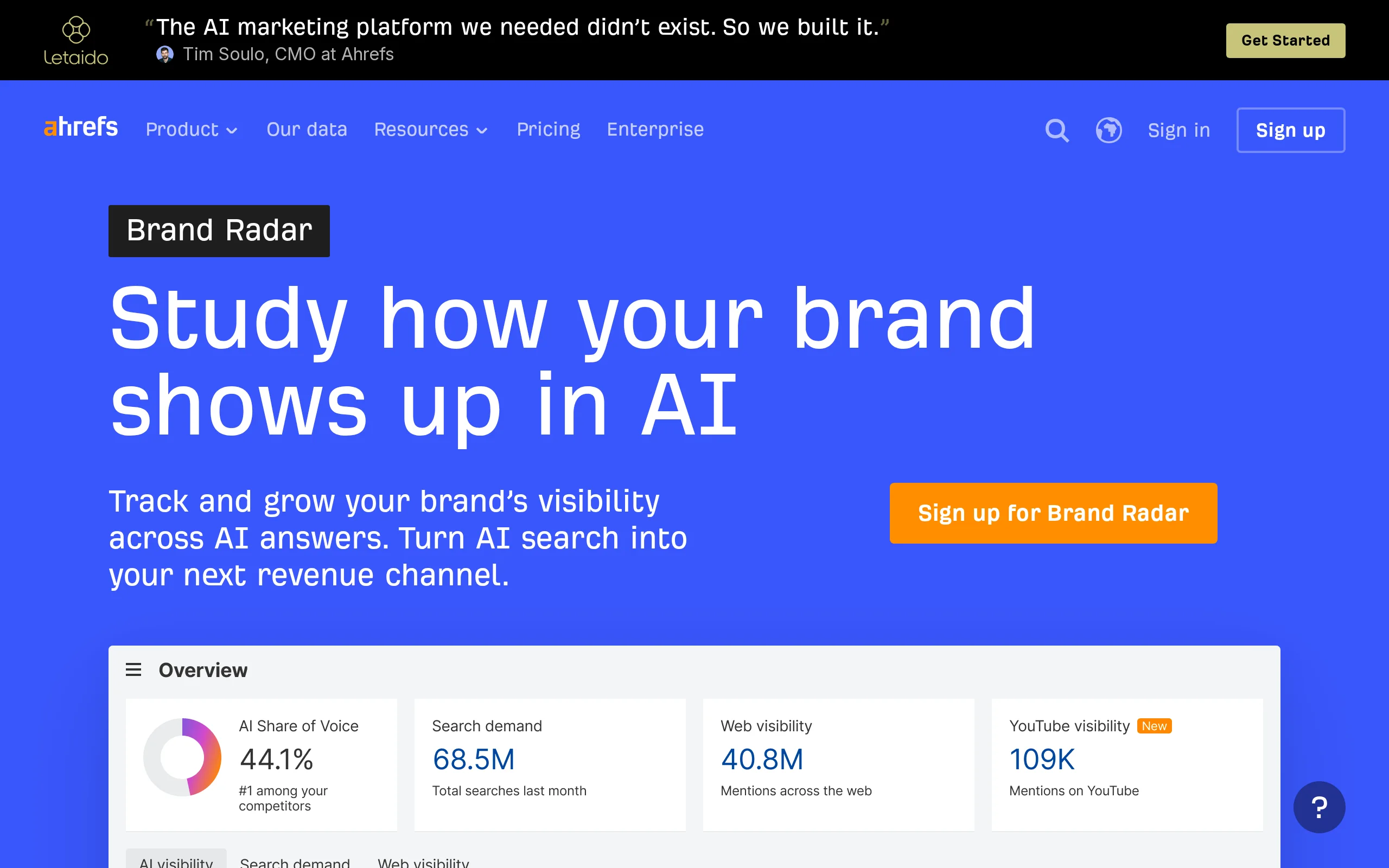
Ahrefs Brand Radar connects AI Share of Voice directly to search demand, web mentions, and organic authority data.
Ahrefs Brand Radar pairs AI visibility tracking with Ahrefs’ massive historical database of over 500 million prompts, backlinks, and organic search demand. Access requires a paid Ahrefs subscription (starting at $129/month on Lite), plus either the Brand Radar index add-on (starting around $199/month per AI index) or custom prompt check packs starting at $50/month (for 2,500 monthly prompt-platform checks, roughly $0.02 per check).
For agencies already built around Ahrefs, connecting AI share of voice and brand mentions directly to referring domains, web mentions, and organic rankings makes root-cause analysis much faster. You can immediately see whether a rival beats your client in ChatGPT because of stronger third-party press mentions or comparison-page coverage. Like Semrush, however, isolated multi-client agency workspaces and white-label client portals are not its primary design goal.
- Choose Ahrefs Brand Radar if Ahrefs is already your core SEO stack and you want historical prompt benchmarks tied directly to backlink and organic authority data.
- Skip Ahrefs Brand Radar if you need standalone client portals, pitch workspaces, or predictable flat-rate multi-client pricing across a large roster.
Scrunch AI: best for dedicated multi-brand agency pods
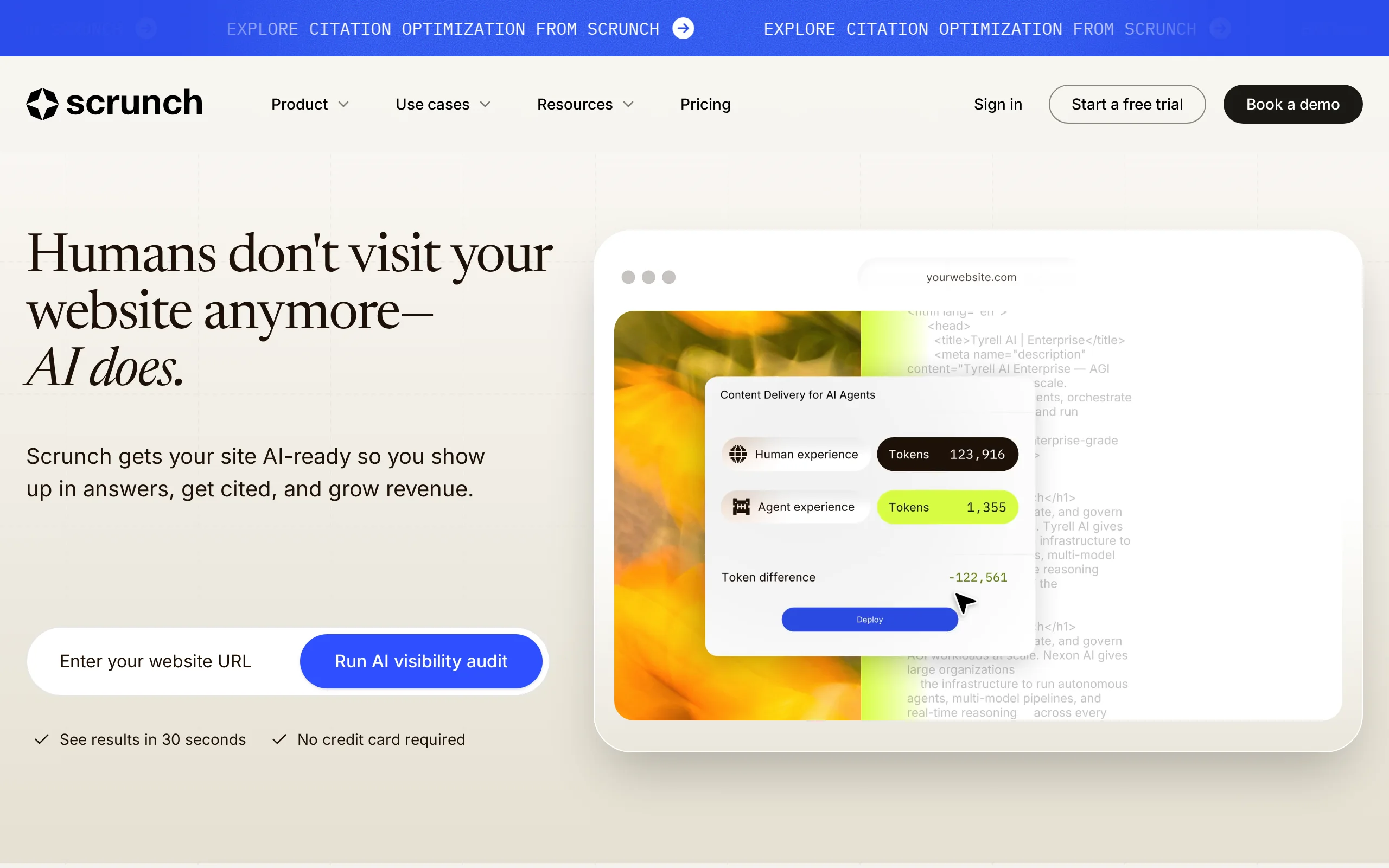
Scrunch pairs brand visibility tracking with technical AI crawl optimization and an Agency Core tier for multi-brand pods.
Scrunch AI is a pure-play AI visibility and crawler analytics platform with a transparent mid-market agency tier. Its Core plan for single brands starts at $250/month (125 prompts, 4 LLMs, 5 site audits), while Agency Core costs $500/month for 3 client brand workspaces, 250 prompts, and unlimited team seats. Agency Enterprise unlocks 9+ LLMs, API access, and custom workspace counts.
Scrunch stands out for pairing brand citation tracking with technical site audits and AI referral tracking, helping agencies tie visibility lifts back to actual bot crawls and incoming sessions. Watch the prompt cap closely: 250 prompts split across three clients is roughly 80 prompts each, which is healthy for mid-sized B2B clients, but scaling to 10+ accounts pushes you onto custom enterprise pricing.
- Choose Scrunch AI if you run a focused agency pod managing high-value accounts and want unlimited seats, crawler insights, and referral tracking in one dedicated interface.
- Skip Scrunch AI if you manage 15+ smaller retainers and need lower cost per client workspace out of the box.
AthenaHQ: best for brand accuracy and hallucination protection
AthenaHQ targets enterprise and regulated brands where accuracy, hallucination detection, and action workflows matter most.
AthenaHQ, built by former Google and DeepMind engineers, combines broad multi-engine monitoring (up to 11 AI engines) with citation analysis, hallucination detection, and automated content-action recommendations. After a free Essential tier (300 credits across 5 engines), its Starter plan costs $295/month ($245/month billed annually) for 3,600 monthly credits, with custom Enterprise tiers for large multi-market rosters.
Because AthenaHQ bills by credit (1 credit equals 1 prompt checked on 1 model), daily tracking across 10 engines burns credits rapidly. Where it shines is brand accuracy for regulated, enterprise, or high-ticket clients (finance, healthcare, B2B SaaS) where an AI assistant quoting outdated pricing or wrong compliance terms costs real pipeline.
- Choose AthenaHQ if your clients care as much about catching AI hallucinations and wrong product claims as tracking raw share of voice, and can fund $295+/month per major account.
- Skip AthenaHQ if you want flat daily tracking across dozens of small clients without managing credit burn rates across models.
SE Ranking and SE Visible: best for consumer-interface tracking at mid-market prices
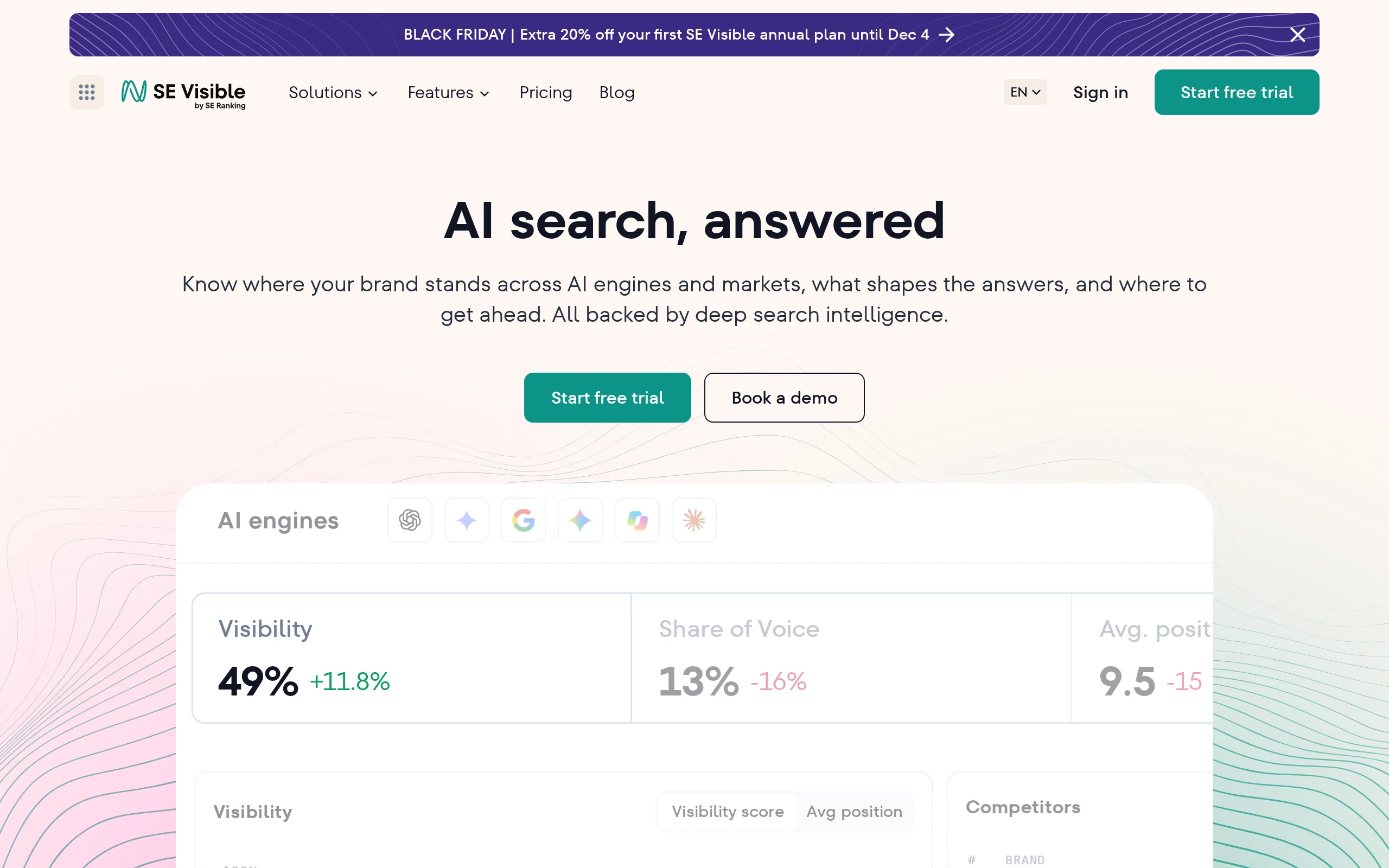
SE Visible delivers browser-collected AI visibility metrics across five client projects on its $89/month entry tier.
SE Ranking offers two clean entry points for agencies. Its core SEO plans (starting at $129/month, or ~$103/month annually) already bundle 25 daily AI prompts, while its standalone AI tracker, SE Visible, starts at $89/month ($71/month billed annually) for 75 daily prompts across 5 projects.
SE Visible’s main selling point for agencies is data collection: it pulls answers from real consumer browser interfaces rather than relying solely on API outputs, making it far easier to defend numbers during a client review. Multi-project pooling on the $89 tier also makes it one of the most cost-effective ways to track five smaller clients at once, though agencies needing full white-label PDF portals should verify current export options before committing.
- Choose SE Ranking / SE Visible if you want consumer-interface AI tracking across 5+ projects under $100/month, or already run rank tracking on SE Ranking.
- Skip SE Ranking / SE Visible if you require enterprise agent workflows, deep hallucination detection, or full custom white-label portals on the entry plan.
Rankscale: best for broad engine coverage and flexible credit allocation
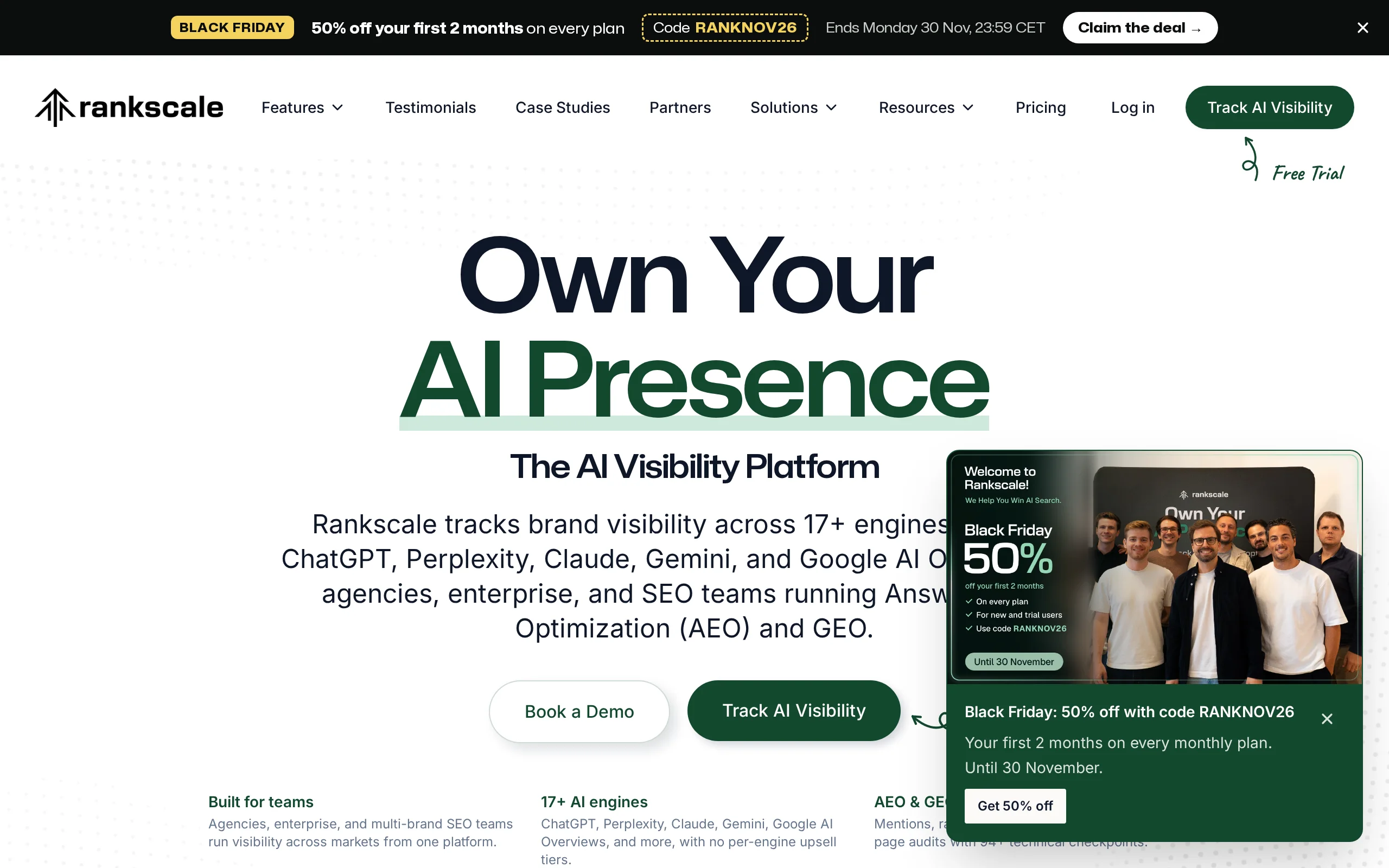
Rankscale tracks 17+ AI engines on a pooled credit model with multi-brand dashboards, REST API access, and white-label tiers.
Rankscale is a configurable GEO tracker built around a flexible credit system covering 17+ AI engines (including ChatGPT, Perplexity, Claude, DeepSeek, Copilot, Gemini, and Google AI Overviews). Essentials starts at $20/month (120 credits), Pro costs $99/month (1,200 credits, 10 brand dashboards, unlimited seats), and Growth to Enterprise plans scale from $229 to $780/month (up to 12,000+ credits with REST API access and white-label client dashboards).
For agencies managing uneven rosters where some clients want weekly checks across 8 models and others want daily checks on 3, credit pooling prevents wasted spend. Moving up to the Growth tier unlocks the API and white-label dashboards most agencies need to standardize reporting.
- Choose Rankscale if your agency serves varied markets (including international clients using DeepSeek or Claude) and wants credit flexibility, 10+ brand dashboards, and API/white-label options.
- Skip Rankscale if you prefer simple fixed prompt allowances over budgeting credit consumption across engines and cadences.
Writesonic GEO: best for agencies pairing tracking with content execution
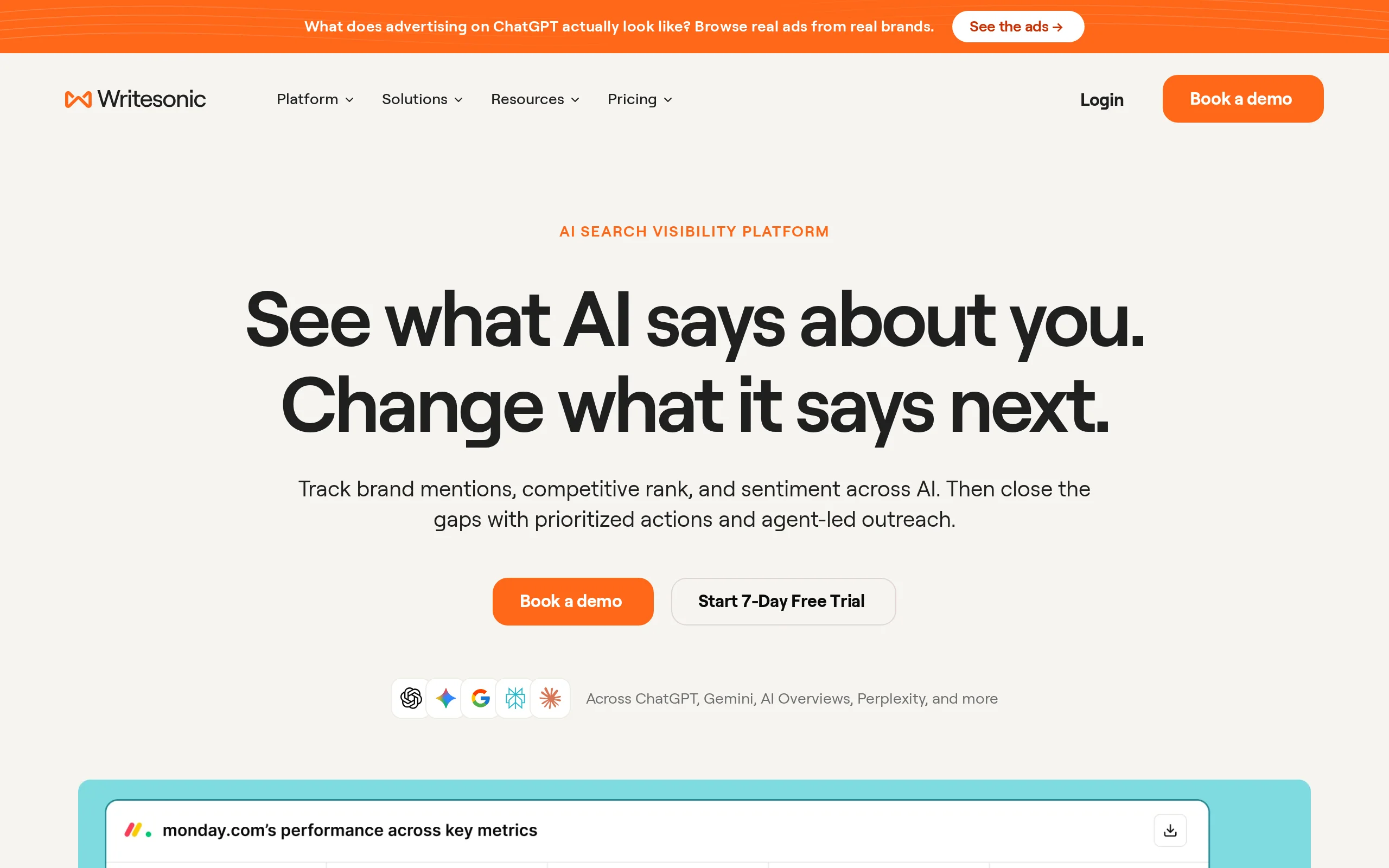
Writesonic GEO ties citation gap monitoring directly into content drafting and page optimization workflows.
Writesonic GEO combines AI visibility monitoring with Writesonic’s long-standing content creation and optimization platform. Entry self-serve plans start around $79 to $99/month (billed annually) covering core engines like ChatGPT, Gemini, and Google AI Overviews, scaling up to 10+ platforms and higher prompt volumes on agency and enterprise tiers.
Rather than handing your team a spreadsheet of citation gaps and leaving execution elsewhere, Writesonic links missing citations directly to content briefs, page refreshes, and drafting assistants. It works best for lean content agencies where the same strategist runs tracking and ships updated comparison or FAQ pages each week.
- Choose Writesonic GEO if you want tracking and AI-assisted content drafting inside one subscription to speed up turnaround on citation gaps.
- Skip Writesonic GEO if your agency enforces strict human-only editorial workflows or already has a dedicated content ops stack and only needs pure measurement.
Which AI visibility stack fits your agency roster?
Most agencies waste money either by buying enterprise software too early or by stacking per-domain add-ons that collapse at 10 clients. Match your stack to your active roster size:
| Agency profile | Recommended primary tool | Supporting layer | Typical monthly software spend |
|---|---|---|---|
| Boutique (3 to 8 clients) | Otterly.AI Standard ($189) or SE Visible Basic ($89) | Free Search Console + Bing Webmaster Tools + Screaming Frog | $90 to $220 |
| Mid-sized (10 to 25 clients) | Otterly.AI Premium ($489) or Peec AI Agency ($495 to $795) | Looker Studio connector + Rankscale ($99) for niche models | $500 to $900 |
| Enterprise (25+ or flagship accounts) | Profound Agency Growth/Enterprise or AthenaHQ | Custom BI/API warehouse + CDN AI crawler logs | $2,000+ (passed through in retainers) |
| SEO-suite-first agency | Semrush AI Visibility ($99/domain) or Ahrefs Brand Radar ($50 to $199) | Keep 1 to 3 anchor clients in-suite; move overflow to Otterly.AI or Rankscale | $150 to $500 |
Every tier above should share the same free first-party layer before spending a dollar on third-party tracking:
- Google Search Console to monitor impressions and clicks on queries triggering AI Overviews and AI Mode.
- Bing Webmaster Tools for AI citation reporting across Copilot and Bing summaries.
- CDN or server crawler logs (such as Cloudflare AI Crawl Control, available on free plans) to verify that
OAI-SearchBot,PerplexityBot, andGoogle-Extendedcan actually fetch your clients’ key commercial pages.
Why free AI graders and single-run checks fail in client reviews
Many agencies start pitching GEO using free “AI visibility grader” widgets or by typing five prompts into their own ChatGPT account. Both approaches backfire as soon as a sharp client asks follow-up questions:
- Non-deterministic answers: AI engines vary from run to run. A single check can show a client missing from an answer where they actually appear in two out of three runs. Credible agency panels repeat each prompt multiple times and report trend lines over weeks, not single screenshots.
- Account memory and personalization: Checking ChatGPT or Gemini from your own signed-in account reflects your browsing history, location, and memory. What you see is not what a cold buyer sees.
- Opaque prompts: Free graders lock you into generic prompts you cannot inspect or rerun next month. They are lead-generation magnets for software vendors, not measurement baselines.
Start every client engagement with a fixed panel of 30 to 100 commercial buyer prompts split across category discovery, head-to-head comparisons, pricing questions, and problem-led queries, tracked alongside three to five named competitors. If you are deciding how to structure the broader program around those metrics, see our guide on SEO and AI search visibility for marketing buyers.
How we evaluated these tools
We reviewed vendor pricing pages, product documentation, and public agency partner terms in November 2026. Pricing in the AI visibility market shifts frequently, so confirm current prompt caps, engine inclusions, and annual billing terms before locking in a contract. All figures are in US dollars.
We weighted each platform on what affects agency margin and client retention in practice: multi-client workspace isolation, seat limits, prompt pooling versus per-domain fees, pitch workflow support, browser versus API collection transparency, citation URL depth, and reporting exports (Looker Studio, white-label dashboards, and REST APIs).
If your team needs help turning AI visibility tracking into measurable pipeline and lower blended CAC, see our Organic and AI Discovery practice, review our engagement models, or start a conversation.
Sources
- Gartner: Gartner Predicts Search Engine Volume Will Drop 25% by 2026, Due to AI Chatbots and Other Virtual Agents (February 2024)
- Pew Research Center: Google users are less likely to click on links when an AI summary appears in the results (July 2025)
- Ahrefs: AI Overviews Reduce Clicks by 34.5% and AI Overviews Reduce Clicks (Updated Longitudinal Study: 58% CTR Drop) (2025–2026)
- Bain & Company: Goodbye Clicks, Hello AI: Zero-Click Search Redefines Marketing (2025)
- SparkToro & Datos: 2024 Zero-Click Search Study
- Semrush: AI Search Study
- Writesonic: Do AI Engines Cite the Same Sources? A Study of 161,286 Prompts (July 2026)
- Vendor pricing and documentation (checked November 2026): Profound, Peec AI, Otterly.AI, Semrush SEO & AI Search, Ahrefs Brand Radar, Scrunch AI, AthenaHQ, SE Visible, SE Ranking, Rankscale, and Writesonic.


